

Great Lakes Factsheet
The Great Lakes form the largest freshwater lake system on Earth. Covering 95,160 mi2 (246,463 km2), they hold 6 quadrillion gallons of water;¹ 20% of the world’s fresh surface water supply and 90% of the U.S. supply.2 The lakes are shared by eight U.S. states, two Canadian provinces, and many sovereign tribes and First Nations.3
Image of the Great Lakes4,66
Patterns of Use
Wildlife
- The basin is home to over 3,500 plant and animal species,2 including 188 non-native aquatic species, of which 64 are considered invasive.6
- Over 5M people fish the Great Lakes annually, for species like salmon, walleye, trout, and muskellunge.12
- In 2022, commercial fisheries in Michigan produced over 2M lbs of fish worth more than $5.4M, with lake whitefish being the largest catch at a total of 1.7M lbs ($5.1M).14
- Invasive species cost Great Lakes states $100M annually, affecting fisheries, agriculture, and tourism.18 Only four non-native aquatic species established in the area between 2011 and 2020,6 an improvement from 19 in the previous decade.16
People
- The lakes provide drinking water for more than 40M people.2 Primary water uses are electricity generation (71%), public water supply (14%), and industrial facilities (10%).65
- There are 3.9M recreational boats registered in Great Lakes states (⅓ of the U.S. total).8 The recreational economy from fishing, hunting, boating, and wildlife watching is valued at $81B;29 fishing is worth $5.1B, supporting 35,800 jobs.30
- The Great Lakes are home to wild rice (manoomin).56 Harvesting is a cultural tradition that ties Indigenous people to ancestral lands.57 Attempts to mass-produce manoomin have sparked conflict, as tribes view it as sacred, not commercial.56
- Researchers at the U.S. Army Corps of Engineers partnered with Great Lakes tribes to monitor and restore wild rice habitats, recognizing Indigenous ecological knowledge as invaluable.58 In 2023, a tribal-state stewardship plan was developed to protect and restore wild rice across Michigan.56
Trade
- There is $278B in annual U.S.–Canada bilateral trade in the Great Lakes region—more than with Mexico, China, UK, Germany, and Japan combined.9
- The U.S. Great Lakes maritime economy supports 311,000 jobs and generates $8.8B in wages across tourism, transportation, and trade.41
- 135.7 Mt of cargo moved through the Great Lakes-St. Lawrence Seaway in 2022 generating $6.3B in federal, state, and local tax revenue.10 Top cargo types are iron ore, grain, stone/aggregate, and coal.
Governance
- The International Joint Commission (IJC), established under the Boundary Waters Treaty of 1909, oversees the shared waters of the U.S. and Canada.53 It manages the Great Lakes Water Quality Agreement, first signed in 1972 to restore and maintain the chemical, physical, and biological integrity of the waters of the Great Lakes.5
- The Great Lakes Commission (GLC), established in 1955, recommends policies and practices to balance development and conservation.19
- The Great Lakes Compact, signed into U.S. law in 2008, bans most diversions of water outside the basin—protecting the region from large-scale withdrawals.54
- The U.S. Environmental Protection Agency (EPA) enforces federal laws protecting water quality, pollution control, and habitat restoration in the Great Lakes. It has invested over $288M to clean up contaminated sediment in designated areas of concern (AOCs).17
- Tribes co-manage alongside federal and state agencies. The Great Lakes Indian Fish and Wildlife Commission (GLIFWC), founded in 1934, represents 11 Ojibwe tribes across Minnesota, Wisconsin, and Michigan.20
- Tribal fishing rights are exercised primarily in two treaty areas: the 1836 Treaty (Washington) covers Michigan’s eastern Upper and northern Lower Peninsulas, and the 1842 Treaty (La Pointe) covers the western Upper Peninsula and northern Wisconsin.21 The Chippewa Ottawa Resource Authority manages the 1836 Treaty,22 focusing on conservation, safety, and law enforcement.23
- The 2023 Great Lakes Decree outlines a 24-year plan for sustainable tribal and state fishery co-management.49
Challenges
- Climate change is exacerbating natural water level variation in the Great Lakes.59 Extreme fluctuations have serious consequences: high water levels lead to erosion and flooding, while low levels disrupt shipping and power generation.24
- In 2024, lakes Michigan, Huron, Erie, and Ontario experienced record high temperatures between 51–57 °F.43 Ice cover hit a historic low of 2.7% in February,44 and peaked just over 17%, far from the average annual maximum of 53%.45
- Forest and wetland loss in the basin continues, with an estimated net decrease of 1,120 mi2 (2,900 km2) in forested land and 225 mi2 (583 km2) in wetlands—reducing the landscape’s ability to filter water and regulate temperature.6
- Industrial chemicals like polychlorinated biphenyls (PCBs), banned in the 1970s, remain present in Great Lakes fish at levels above binational safety targets.46 Targeted actions have significantly reduced their concentrations.
- New threats like cyanotoxins and microplastics pose challenges to water quality in the basin.47 85 previously unknown polyfluoroalkyl substances (PFAS) were identified in Lake Huron’s water and food web in 2024.50
U.S. EPA Lake Quality Assessment, 20226
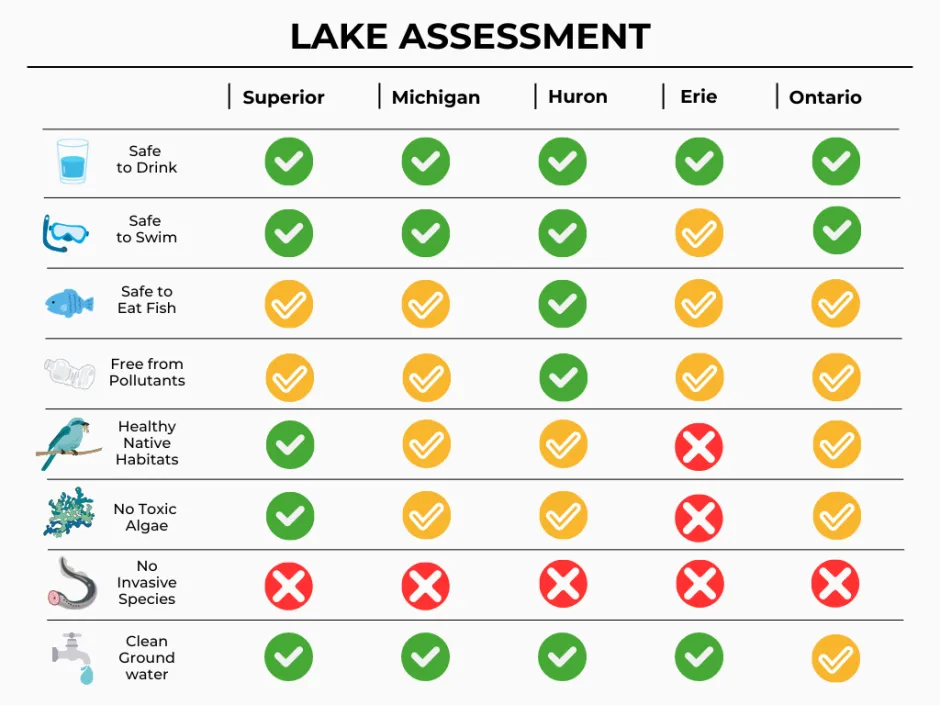
- Litter around the Great Lakes beaches remains a challenge; one Lake Erie beach showed abnormally high levels of debris, with plastics making up 80–100% of visible litter, despite regular grooming.51
- The region has lost 18 native species and 61 are classified as endangered due to invasives, overfishing, and habitat loss.7
- By the late 1960s, invasive sea lampreys had reduced annual lake trout harvests from 15M lbs to 300,000 lbs.31 Population control efforts by the U.S. Fish and Wildlife Service successfully reduced sea lamprey numbers by over 90%.12
- Quagga and zebra mussels, introduced in the 1990s25 from Eurasia via ballast water, are the Lakes’ most devastating invasive species. They disrupt food webs by outcompeting native fish, clog infrastructure, and bioaccumulate toxins.52
- Invasive bighead, silver, and black carp are advancing through the Mississippi River towards the Great Lakes. These fish grow up to 100 lbs, and outcompete and consume native fish.37
Solutions and Sustainable Actions
- $1.23B in federal cleanup grants since 2004 reduced industrial pollution in AOCs and are estimated to have increased nearby housing values by at least $8.7B.48
- Efforts have shifted from reactive to proactive as prevention is the most cost-effective approach;32 in 2024, construction began on the Brandon Road Project near Joliet, IL—a multi-layered barrier system using electric barriers, flushing locks, sound, and more—to block invasive carp from entering the Great Lakes.37
- The Great Lakes Restoration Initiative (GLRI) has trapped 6M lbs of invasive carp in the Illinois river,34 prevented 2.3M lbs of phosphorus runoff,60 and restored more than 460,000 acres of habitat.61 Every $1 spent generates an estimated $3.35 in long-term benefits through 2036.34
- Michigan Sea Grant has received over $2M in federal funding from the GLRI to support research on endangered fish and invasive species. The program has revived declining fish populations and revitalized coastal brownfields, improving local economies and water quality.33
- Continued federal funding for these efforts remains uncertain, putting long-term progress at risk.64
- The Alliance for the Great Lakes’ research and policy recommendations guided Michigan’s Domestic Action Plan,63 which targets a 40% phosphorus reduction by 2025 to combat harmful algal blooms in Lake Erie.37
- The Great Lakes Climate Adaptation Partnership Team, a joint initiative between the NOAA, University of Michigan, and Michigan State University,35 has supported over 175 partners planning for climate variability and monitoring water levels.36
- The EPA Clean Ports Program, funded by the Inflation Reduction Act, supports transition to zero-emission equipment at U.S. ports.39 Michigan’s MI Clean Ports Program, launched under this initiative, supports efforts to decarbonize and electrify the state’s marinas and watercraft.40
- The Clean Marina Program certifies marinas that adopt best practices for water, waste, and habitat protection through partnerships with Sea Grant, EPA, and industry.55
- In 2023, the Council of the Great Lakes Region launched a boat wrap recycling pilot in Chicago and Lake County, IL to build a circular economy for plastics in the Great Lakes.62
Center for Sustainable Systems, University of Michigan, Ann Arbor. 2025. “Great Lakes Factsheet.” Pub. No. CSS25-23.
References
1. International Joint Commission. Great Lakes Water Quality. Accessed May 6, 2025.
https://www.ijc.org/en/what/glwq
2. Great Lakes Commission. About the Lakes. Accessed May 6, 2025.
3. Payton, E.A., et al. Chapter 4: Water. In Fifth National Climate Assessment, edited by A.R. Crimmins et al. Washington, DC: U.S. Global Change Research Program, 2023.
https://nca2023.globalchange.gov/chapter/4/#key-message-3
4. Great Lakes Science Center. MODIS Satellite Image of the Great Lakes | U.S. Geological Survey.
https://www.usgs.gov/media/images/modis-satellite-image-great-lakes
5. International Joint Commission. The IJC and the Great Lakes Water Quality Agreement.
https://www.ijc.org/en/what/glwqa-ijc
6. Environment and Climate Change Canada and U.S. Environmental Protection Agency. State of the Great Lakes 2022 Report. July 2022.
https://binational.net/wp-content/uploads/2022/07/State-of-the-Great-Lakes-2022-Report.pdf
7. Great Lakes Fishery Commission. The Great Lakes Fishery.
https://www.glfc.org/pubs/factsheets/FACT%202_14-0913_HR.pdf
8. U.S. Coast Guard Office of Auxiliary and Boating Safety. Recreational Boating Statistics 2023: Chapter 2.
https://www.uscgboating.org/library/accident-statistics/Recreational-Boating-Statistics-2023-Ch2.pdf
9. Council of the Great Lakes Region. The Great Lakes Economy.
https://councilgreatlakesregion.org/the-great-lakes-economy-the-growth-engine-of-north-america/
10. Martin Associates. Economic Impacts of Maritime Shipping in the Great Lakes–St. Lawrence Region.
12. Great Lakes Fishery Commission. Sea Lamprey Control in the Great Lakes. 2014.
https://www.glfc.org/pubs/factsheets/FACT%205_all.pdf
14. Michigan Department of Natural Resources. 2022-Harv--Data.
16. Environment and Climate Change Canada and U.S. Environmental Protection Agency. State of the Great Lakes 2009 Report. October 2009.
https://binational.net/wp-content/uploads/2014/05/sogl_2009_h_en-1.pdf
17. U.S. Environmental Protection Agency, Great Lakes Restoration, and Great Lakes Commission. Revitalizing Local Waterfront Economies: Investing in the Great Lakes.
https://www.glc.org/wp-content/uploads/2016/10/2011-revitalizing-local-waterfront-economies.pdf
18. Rosaen, Alex L., et al. The Costs of Aquatic Invasive Species to Great Lakes States. East Lansing, MI: Anderson Economic Group LLC, 2016.
19. Great Lakes Commission. About the Great Lakes Commission.
20. Great Lakes Indian Fish and Wildlife Commission. About GLIFWC.
21. Michigan Department of Natural Resources. Tribal Coordination.
https://www.michigan.gov/dnr/managing-resources/fisheries/tribal
22. Chippewa Ottawa Resource Authority. Chippewa Ottawa Resource Authority – Preserving the Resource for Future Generations.
23. Chippewa Ottawa Resource Authority. Fishing Regulations Revised March 14, 2024.
24. Baker, J., et al. “Chapter 24: Midwest.” In Fifth National Climate Assessment, edited by A.R. Crimmins et al. Washington, DC: U.S. Global Change Research Program, 2023.
https://nca2023.globalchange.gov/chapter/24/
25. Pollack, L., et al. Sixteenth Biennial Report on Great Lakes Water Quality. International Joint Commission, 2013.
https://www.ijc.org/sites/default/files/16thBE_internet%2020130509.pdf
29. Great Lakes Commission. Federal Priorities 2025.
https://www.glc.org/library/2025-glc-federal-priorities
30. Great Lakes Fishery Commission. Great Lakes Valuation Report 2022.
https://www.glfc.org/pubs/factsheets/Great-Lakes-Valuation-factsheet.pdf
31. Great Lakes Fishery Commission. Sea Lamprey.
https://www.glfc.org/pubs/factsheets/FACT%204_14-0913_HR.pdf
32. Great Lakes Commission. Policy Resolutions October 8–10, 2024.
https://www.glc.org/work/advocacy/resolutions/
33. Michigan Sea Grant. Restoration.
34. Great Lakes Commission. Assessing the Investment: The Economic Impact of the Great Lakes Restoration Initiative.
https://www.glc.org/wp-content/uploads/GLRI-Fact-Sheet-20180924.pdf
35. GLISA. Mission.
https://glisa.umich.edu/about/mission/
36. GLISA. Impact.
https://glisa.umich.edu/our-work/impact/
37. Michigan Department of Environment, Great Lakes, and Energy. Michigan State of the Great Lakes 2024 Report.
39. U.S. Environmental Protection Agency. Clean Ports Program “Fast Facts” – Questions and Answers.
https://nepis.epa.gov/Exe/ZyPDF.cgi?Dockey=P101A2VI.pdf
40. Michigan Infrastructure Office. Michigan Wins More than $25 Million from Biden-Harris Administration to Invest in Its Ports, Support Thousands of Jobs and Strengthen Supply Chains. State of Michigan, October 30, 2024.
41. National Oceanic and Atmospheric Administration, Office for Coastal Management. Great Lakes.
https://maps.coast.noaa.gov/states/fast-facts/great-lakes.html
43. NOAA GLERL. Pre-winter Q&A with NOAA GLERL scientists: Water levels, lake temperatures, and winter outlooks for the Great Lakes region.
44. NOAA Research. Great Lakes Ice Coverage Reaches Historic Low.
https://research.noaa.gov/great-lakes-ice-coverage-reaches-historic-low/
45. U.S. National Ice Center. Great Lakes Reaches Maximum Ice Coverage – February 2024. Last modified February 14, 2024.
46. U.S. Environmental Protection Agency. Great Lakes Open Lakes Trend Monitoring Program: Polychlorinated Biphenyls.
47. International Joint Commission. Third Triennial Assessment of Progress on Great Lakes Water Quality.
48. Cassidy, A., Meeks, R. C., and Moore, M. R. (2023). Cleaning up the Great Lakes: Housing market impacts of removing legacy pollutants. Journal of Environmental Economics and Management, 113, 102667.
https://doi.org/10.1016/j.jpubeco.2023.104979
49. Michigan Department of Natural Resources. Great Lakes Decree.
50. Ren, Y., et al. (2025). Suspect screening and nontargeted analysis of polyfluoroalkyl substances in the Great Lakes. Science of the Total Environment.
https://www.sciencedirect.com/science/article/pii/S0380133025000012
51. Jefferson, A., et al. Anthropogenic Litter and Plastics on a Mechanically Groomed Great Lakes Urban Beach. 2025.
52. Lower, E., et al. The Great Lakes’ Most Unwanted Aquatic Invasive Species. 2024.
53. International Joint Commission. Role of the IJC.
https://www.ijc.org/en/who/role
54. Alliance for the Great Lakes. Defending the Great Lakes Compact.
https://greatlakes.org/campaigns/defending-the-great-lakes-compact/
55. Michigan Sea Grant. Great Lakes Clean Marina – State Programs.
https://www.michiganseagrant.org/great-lakes-clean-marina/state-programs/
56. Michigan Wild Rice Initiative. Manoomin Stewardship Guide. March 10, 2025.
https://www.itcmi.org/wp-content/uploads/2025/03/Manoomin-Stewardship-Guide-FINAL-3.10.2025.pdf
57. Harvard Plurality Project. Wild Rice: A Sacred Food. 2020.
https://pluralism.org/wild-rice-a-sacred-food
58. U.S. Army Corps of Engineers. Researchers Collaborate with Native American Tribes to Improve Wildrice Productivity. 2021.
59. Gronewold, A. D., et al. (2021). A tug-of-war within the hydrologic cycle of a continental freshwater basin. Geophysical Research Letters, 48, e2020GL090374.
https://doi.org/10.1029/2020GL090374
60. Great Lakes Restoration Initiative. Action Plan IV Fiscal Year 2025–2029. 2024.
https://www.glri.us/sites/default/files/glri-action-plan-4-202411-43pp_0.pdf
61. Great Lakes Restoration Initiative. Results. 2025.
62. Council of the Great Lakes Region. United Nations Global Compact Communication on Engagement. 2025.
https://councilgreatlakesregion.org/wp-content/uploads/2024/10/2024-06-cglr-coe-final-1.pdf
63. Alliance for the Great Lakes. Impact and History. 2025.
https://greatlakes.org/about/impact-and-history/
64. Alliance for the Great Lakes. News. 2025.
65. Great Lakes Commission. Annual Report of the Great Lakes Regional Water Use Database. 2023.
https://waterusedata.glc.org/reports/annual-reports
66. "Michigan Sea Grant (2025) The Great Lakes Basin"
https://www.miseagrant.com/Great_Lakes_Basin_p/michu-25-701.htm